The Illusion of Speed and Rethinking Breeze-Up Sales
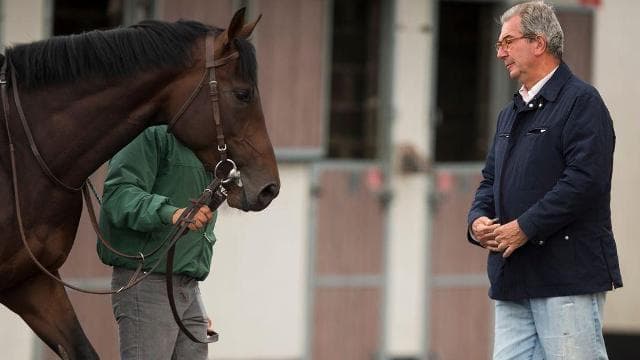
Photo: Jean-Claude Rouget with his champion Almanzor
Ever wondered why most of the leading horse buyers don't buy at the breeze-up sales?
A few years ago, I had the privilege of spending a morning on the gallops in Deauville with leading trainer Jean-Claude Rouget.
During our discussion on breeze-up sales, he made a remark that has stayed with me:
“The problem with the current breeze-up system is that horses are trained to run times. What you see is a precipitated version of their action, not their natural one.” JC Rouget
Coming from a trainer of over 3,000 winners, including 2 Arc de Triomphe’s, 6 French Derbies, 4 French Oaks and about 45 Gr.1 races throughout Europe, that observation carries weight.
Reformatting the Gallop
At the last breeze-up sale I attended, two issues stood out.
1. Over-revved from the outset
At the start of the 200-metre breeze, a large proportion of horses were throwing their heads, a clear sign of anticipation and apprehension before a forced effort.
These horses are revved up rather than composed, conditioned for a sharp 200-metre burst instead of being taught to build gradually and lengthen their stride.
This is not something you see in leading training establishments with 2-year-olds at the same age and stage.
2. Interrupted at full stride
Horses were then asked to enter a bend just as they hit top gear, forcing riders to steady immediately after asking for maximum effort.
This is:
-
Misleading for the buyer — you don’t see a horse sustain its action or carry speed after the line
-
Confusing for the horse — just as it commits and lengthens, it is asked to shut down
In essence:
You ask for full extension, then immediately take it away.
This method goes against logic and good training.
A System Built Around the Clock
As we prepare for upcoming breeze-up sales, a clear pattern is emerging.
Too many horses are:
-
Over-trained
-
Over-revved
-
Pushed to produce a fast 200-metre time
This is something no leading trainer would impose on a young two-year-old at that stage.
There is a fundamental disconnect between:
-
A horse prepared for a breeze-up
-
A horse prepared for a racing career in a leading racing stable
And yet, the end goal is the same: to win races.
What Are We Really Measuring?
The system rewards speed on the clock and precocity, but at what cost?
When a horse is pushed beyond its natural rhythm:
-
Its action shortens
-
Its knees lift unnecessarily
-
Its balance alters
-
Its movement becomes forced
-
It becomes vulnerable to injuries
You are no longer assessing the horse; you are assessing the pressure applied to it.
Education Over Exhibition
If breeze-ups are to gain credibility, the focus must shift from speed to education.
As a buyer, I am far less interested in a fast sectional than in:
-
Natural action at a controlled tempo
-
Ability to do pace work in a bunched-up field
-
Behaviour in the gates
-
Exposure to stable life:
-
Treadmill
-
Swimming
-
Water walker
How well a horse jumps out of the gates is particularly important, as many races have been won or lost at the barriers.
So why not film and showcase:
-
Can the horse stand quietly for five minutes?
-
Can it jump cleanly and travel straight under as little rider interference at this early stage?
The Bias Toward Speed
The current format favours:
-
Early, precocious types
-
Sprint profiles
While penalising:
-
Later-maturing horses
-
Middle-distance prospects
In an era where patience is increasingly rewarded, the question is simple:
What’s the rush?
“Ready to Run” — A Misleading Label
Let’s be honest.
The term “Ready to Run” is misleading.
In Australia:
-
Most breeze-up graduates are not ready to run
-
Many require:
-
A spell
-
Physical recovery
-
Often joint treatment
In reality, they are often further from racing than advertised.
What Needs to Change
1. Remove the emphasis on times
Every horse has a different action, stride, and distance profile.
Reducing them to a fixed 200m and to a clock number is not horsemanship—it’s simplification.
Every vendor should choose how long and how fast each horse should be galloping, depending on their attributes.
Maybe the sales company should set 3 different gallop formats, for example:
-
Sprinters over 400m
-
Milers over 600m
-
Stayers over 800m
2. Rename the product
Call them what they are:
A 2-year-old sale and not “Ready to Run.”
3. Refocus on education
The goal should be to present and promote horses that are:
-
Mentally composed
-
Physically prepared
-
Professionally educated
-
Capable of handling the close contact of peace work in a bunched-up field
Teach them to:
-
Stand in barriers
-
Jump cleanly
-
Handle pressure
A breeze-up horse should be closer to entering work, not closer to breaking down.
Final Thought
We want to be buying at breeze-up sales in Australia for the next 20 years.
With such good prize money on offer in Australia, many buyers have been sceptical about buying from the breeze-up sales, but the mindset is evolving.
From Europe, I can clearly see the merit and opportunity that breeze-up sales present. Onesto, Vandeek, Native Trail, Bradsell and Lezoo are just some of the incredibly talented horses/stallions to have come through the NH breeze-up market, and I believe we can achieve similar results here. Their system isn’t faultless either, but it has produced champions.
In Australia, the current system doesn't have the support of the big buyers, and these are the reasons why.
Photo: Vandeek winning the Gr.1 Prix Morny at Deauville